
Defining Verifiable Signs in Wildlife Biology
I spend my days chasing ghosts. People call in with stories of a massive, long-tailed cat crossing the highway at dusk. But a story cannot be measured. A field biologist begins by asking whether the evidence can be revisited, photographed, mapped, and independently checked—a standard that leaves no room for imagination.
In that sense, a wildlife sign is not a narrative about an animal. It is physical, verifiable evidence left in the environment. Tracks, scats, and scrapes are the foundational, objective metrics used by wildlife biologists to confirm the presence of large carnivores in a specific habitat. They contrast directly with anecdotal sightings.
Main Point: A verifiable sign should be documented with location, substrate, date, weather conditions, and a scale reference. Photographs must be taken both straight down and obliquely.
These physical markers are stronger than visual reports because they can be compared directly against known disturbance patterns of canines, bobcats, bears, and humans.
Robert L. Downing and the 1980s USF& WS Survey
The shift from collecting rumors to demanding physical proof did not happen overnight. Robert L. Downing, a dedicated biologist who led the official USF& WS eastern cougar survey during the 1980s, forced a critical procedural change.
Reports were suddenly sorted by the quality of confirmable evidence rather than by the sheer volume of public sightings. During this multi-year survey period, eastern cougar claims were evaluated across a wide geographic region rather than at a single den, kill site, or study plot. Track verification centered on clear impressions where individual toes and the rear heel-pad edge could be inspected. Mud, damp sand, or snow with enough firmness to preserve shape provided the optimal conditions.
While Downing's 1980s survey set the standard for track verification, these morphological rules apply strictly to clear substrates. Degraded tracks can easily obscure critical details. Leaf litter, thawing snow, wind-crusted snow, overstepped mud, and partial heel impressions can erase the toe offset and the three-lobed rear pad.
Analyzing Track Morphology: Lobes and Symmetry
The track decision should start with structure, not with the absence of claw marks. A large dog walking through soft mud can leave a round, clawless-looking track if the claws do not register. Conversely, a cougar can show claw marks while slipping, turning, climbing, or accelerating. Claw absence alone is a common failure case in identification.
Instead, look at the heel pad. Cougars possess a distinct three-lobed rear heel pad. Many dog tracks show a single rear lobe, a straighter rear edge, or a more triangular central pad.
Next, examine the overall foot structure. A cougar track is inherently non-symmetrical. One toe leads, and the inside and outside toes do not mirror each other cleanly. A vertical split through the track produces unequal halves. This leading middle toe gives the print a layout structurally similar to the asymmetrical layout of a human hand, where one digit projects ahead of the others instead of forming a neat canine arc.
Caution: A cougar track in melting snow may widen and lose its heel-pad lobes, making it look more canine than the original fresh print. A bobcat can show the exact same feline asymmetry and three-lobed pad pattern at a smaller scale. Track size and stride context matter immensely when distinguishing a bobcat from a juvenile cougar.
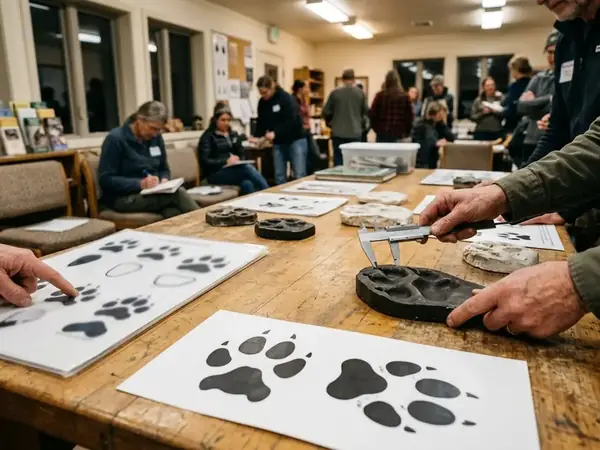
Evaluating plaster casts from confirmed habitats, I find that structural asymmetry remains the most reliable indicator of feline origin.
Identifying Behavioral Markers: Scrapes and Logs
Behavioral signs are weighed as supporting evidence, not as isolated proof. A suspected cougar scrape gains value when it appears alongside compatible tracks, travel-route logic, or repeated marking features.
Contrast territorial marking behaviors. Domestic dogs and coyotes commonly leave kicked debris that fans outward behind them, displaying less consistent mound shape and less precise placement. A cougar scrape is usually a deliberate pile of leaf litter, soil, pine needles, or snow pulled together by the hind feet. They neatly pile this material—often adding urine or scat on or near the mound, to mark their territory.
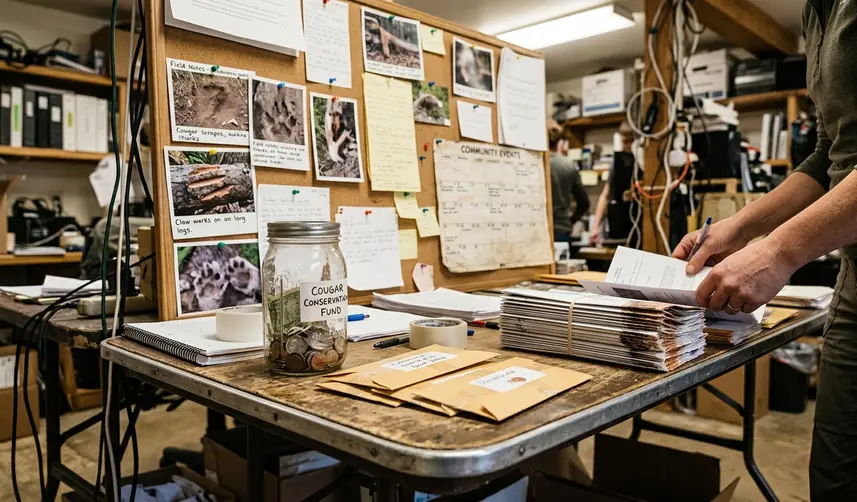
Fallen logs offer another clue. Feline clawing may leave repeated parallel gouges or a distinct saw-tooth pattern where the claws caught and released along the wood grain. This scratching sequence serves as a critical secondary verification sign in the field when tracks or other cougar evidence are nearby.
Expert Tip: If you find scat near a well-formed scrape, collect it carefully. Modern DNA analysis of scat provides a proven confirmation of species and origin, elevating a strong physical sign into undeniable biological proof.
Step-by-Step Field Analysis of a Suspected Track
A copyable field analysis should preserve the print before interpreting it. First, photograph the suspected track with a scale beside it. Then, make the morphology checks without stepping into the travel path.
Here is the exact sequence to follow when you find a promising print.
- Step 1: Draw an imaginary horizontal line across the highest points of the four toes. In a cougar print, one middle toe should sit forward of the line rather than all toe tips forming a smooth, even canine arc.
- Step 2: Mentally bisect the track from front to rear. A cougar print should not divide into two matching halves. The toe placement should feel offset, much like a left or right hand.
- Step 3: Examine the rear edge of the main heel pad. Count the lobes before naming the track. Three rear lobes support a cougar identification, while a single rear lobe or straight rear edge argues against it.
- Step 4: Check the surrounding travel line for supporting signs. Look for additional asymmetrical tracks, a direct walking pattern, a scrape, or a clawed log. Do not rely on one distorted print if the rest of the trail contradicts it.
Document the entire sequence of steps, package your photographs with the scale clearly visible, and log the exact GPS coordinates of the clearest impression.