
In this Article
- The eradication baseline behind modern cougar conservation literature
- Why The Beast in the Garden matters for ecotones and habituation
- How aversive conditioning works at the settlement edge
- What Beast of Never adds through photographic evidence
- How tracks, scat, and DNA analysis change the evidentiary standard
- What coexistence asks of people before it asks anything of cougars
The Historical Toll and the Need for Conservation Literature
Between 1900 and 1950, an estimated 66,000 cougars were killed in the West.
That is where this review has to begin. Not with awe. Not with campfire mystery. Mortality records explain why cougar conservation books carry more weight than ordinary natural history writing. The first half of the twentieth century is the eradication baseline. Every later argument about recolonization, rewilding, habitat capacity, and public tolerance has to be read against that removal campaign.
I read these books as field evidence with sentences attached. The question is not whether a writer loves mountain lions. The question is whether the book helps us make cleaner decisions about habitat, prey, conflict risk, and verification.
Helen McGinnis, an Eastern Cougar Foundation volunteer guiding this review, brings the right pressure to the shelf. Her role here is not to rank books by literary charm. It is to ask which texts still help conservation workers, local officials, and skeptical readers separate useful evidence from inherited fear.
Why the older baseline still matters
Modern cougar debates in the East often start too late. They begin with a trail-camera rumor, a livestock complaint, or a blurred roadside account. The older literature forces a longer frame. Cougars were not absent from many places because forests lacked meaning or prey lacked value. People removed them.
Once that point is clear, conservation literature becomes practical. It records how humans create risk, how predators learn around us, and how evidence must be handled before it becomes policy.
The Beast in the Garden: Ecotones and Habituation
David Baron's 2004 book, The Beast in the Garden, works because it follows behavior through time. It does not treat conflict as a lightning strike. The Boulder story begins with the first cougar tracks recorded on South Boulder Peak in December 1987 and moves toward the fatal cougar attack on a jogger on January 14, 1991.
That timeline matters. It gives the reader a sequence, not a scare.
The strongest concept in the book is the ecotone. Here, ecotones are transition zones where residential expansion, open space, ornamental vegetation, and deer concentration meet. They are not simply edges on a map. They are feeding systems. A suburban ecotone with abundant deer and tolerant human behavior creates different cougar-management problems than a remote forest corridor used only by a dispersing animal.
Boulder County wildlife biologist Michael Sanders appears in the account as an observer of a behavioral shift. Mountain lions that once acted like elusive animals in rough country increasingly treated human-dominated edges as usable habitat. That change did not require malice from the cats. It required repeated access to prey and low immediate cost near people.
How kittens learn the edge
Habituation is often described as if one bold adult makes one bad decision. Baron's account is more troubling than that. Cougar kittens learn from their mothers. If a female hunts successfully around houses, trails, and deer-rich ornamental landscapes, her young may absorb the lesson that human presence is background noise rather than danger.
That is the management knot. By the time a young cougar uses yards or trail corridors routinely, the behavior may already have a family history.
Main Point: Ecotones do not merely attract deer; they can train predators to treat the human edge as normal hunting country.
Aversive Conditioning: Managing Predators at the Edge
Aversive conditioning tries to put friction back into places where people have unintentionally removed it.
In Baron's work, the management discussion moves from diagnosis to intervention. If young cougars learn tolerance from mothers using suburban prey zones, managers try to reintroduce a cost to approaching people. The techniques discussed include rubber bullets and physical removal when an animal repeatedly associates human spaces with food or safety.
The operational goal is behavioral correction. Make the animal link close human proximity with an unpleasant consequence before the behavior hardens into routine use of yards, trails, or settlement edges.
This is not punishment for existing. It is a targeted attempt to preserve distance. In carnivore work, distance is not a sentimental value. It is the condition that lets a predator remain wild and lets people keep fear from turning into lethal response.
Where the tool runs out
Here the book's lesson gets uncomfortable for communities. Aversive conditioning can interrupt risky behavior, but its long-term value is limited when the same ecotones continue to concentrate deer and provide dependable hunting opportunities near people. Rubber bullets cannot outwork an endless buffet.
Aversive conditioning can fail when communities continue feeding deer, protecting ornamental browse, or leaving pets exposed in the same edge habitats that attracted the predator. The animal receives two lessons at once: humans hurt at close range, and human landscapes feed well. That is a poor training environment.
Caution: Behavioral tools are weakest when the landscape keeps rewarding the behavior managers are trying to stop.
The replication lesson is plain. Communities that want aversive conditioning to matter have to pair it with deer management, pet protection, and less permissive edge habitat. Otherwise the tool becomes a response after the real invitation has already been sent.
Beast of Never: Photographic Evidence and Field Research
The review of Butz's Beast of Never shifts the standard of persuasion from anecdote to documentation. That shift is needed in eastern cougar discussions because the region has accumulated generations of stories, some sincere, some mistaken, and some impossible to test.
Pat Rusz's field-centered work matters because the book does not ask readers to accept every regional report as proof. It pays attention to records that can be examined. That is a different discipline.
The text discusses the 1993 Oscoda County cougar photograph as a concrete visual record in a region often described as lacking resident large carnivores. It also examines the 1997 Alcona County cougar photographs, adding a second dated photographic reference point rather than relying on a single isolated claim.
Those dates and locations change the conversation. The question becomes less theatrical and more biological: were some animals transient, released, escaped, or signs of a broader recolonization pattern?
What a dated photograph can and cannot do
A cougar photograph without date, location context, or corroborating field sign can raise suspicion but cannot, by itself, settle origin or residency. That sentence should be taped above every public meeting table where a single image gets passed around as final proof.
Good photographic evidence narrows the argument. It can show that a cougar-like animal stood in a particular place at a particular time. It may support follow-up searches for tracks, scat, hair, or prey remains. It does not automatically establish a breeding population.
This is where Beast of Never earns its place in the conservation stack. It respects field excitement without surrendering to it.
The Science of Tracking and DNA Analysis
Field evidence disappears fast. Rain softens a track. Sand collapses. Curious people step through the best print. Scat dries, breaks apart, or gets moved by weather and scavengers. The literature is useful because it treats evidence collection as a race against loss.
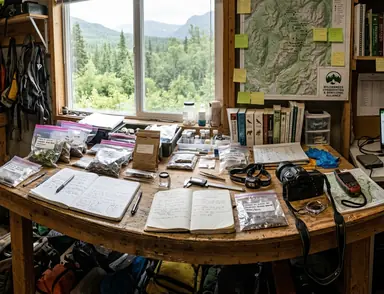
Plaster casts are one of the simplest tools in that race. They preserve track evidence before weather, substrate collapse, or human traffic destroys detail. A cast does not answer every question, but it gives investigators something better than memory: toe arrangement, pad shape, size, and the physical context of the print.
Scat analysis adds another layer. Looking for deer hair helps connect the animal to local prey use rather than treating presence as a visual rumor. For cougar work, diet evidence matters because it ties the animal to the ecological setting. A passing shape in headlights is one kind of claim. Biological material associated with local prey is another.
The evidentiary ladder
The literature moves from tracks and photographs toward biological verification. That ladder is not a snub to observers. It is how carnivore biology protects itself from wishful thinking and premature dismissal.
Melanie Culver's DNA research enters here as the decisive tool for determining cougar origin. Genetic evidence can distinguish North American cougar genetics from Latin American lineages, which matters when investigators need to evaluate whether an animal is likely wild-origin or linked to captivity. The FERC category means Former Escaped or Released Captive, and DNA evidence is central to weighing that possibility.
For eastern cases, the method answers origin more directly than it answers future breeding status. A verified animal is not the same thing as a resident population. That distinction is not evasive; it is the line between evidence and overreach.
For readers who want the institutional side of this work, the USGS Fort Collins Science Center describes wildlife genetics and DNA analysis as tools for identifying animals, populations, and related conservation questions.
Expert Tip: Treat photographs, casts, scat, and DNA as linked evidence, not rival forms of proof. Each one answers a different part of the cougar question.
The Future of Coexistence
The two books converge on a hard lesson: coexistence starts before the cougar arrives at the yard.
From The Beast in the Garden, the lesson is habituation. Cougars learn from landscapes that reward them. Deer-rich edges, careless pet routines, and calm human tolerance can teach the wrong lesson long before a conflict makes the news.
From Beast of Never, the lesson is verification. Evidence deserves patience. A photograph may matter. A track may matter. Scat may matter. DNA may matter most when origin is the central question. But each record has to carry its context with it.
Habitat management ties the two books together. If expanding ecotones keep concentrating deer near human settlement, then communities will keep producing conditions that invite predators into the wrong places. Conservation cannot be reduced to admiring large carnivores at a distance while arranging our neighborhoods to feed their prey at close range.