The Challenge of Verifying Elusive Predators
How do wildlife biologists definitively distinguish a native eastern cougar from an escaped captive pet when physical evidence is finally recovered? This question drives my work every time a field report crosses my desk. For decades, the elusive search for definitive proof of Felis concolor couguar in eastern habitats has frustrated conservationists. The verification problem begins the moment a tangible sample appears. We must first separate the question of species presence from the question of origin.
A photograph, track, hair, scat, or bite wound might confirm a large feline—but it does not tell us where that animal came from. In the past, relying on eyewitness reports alone failed to meet conservation or legal standards because origin, captivity history, and genetic lineage could not be resolved from observation. We needed a different approach. This article examines the protocols used to analyze physical evidence, using incidents from Ontario and Kentucky as paired examples of how we handle field evidence and recovered specimens.
The Cornwall Incident: Securing Physical Evidence
On August 4, 2001, an alleged cougar attack was reported in Cornwall, Ontario, resulting in David Wood being bitten. In cases involving human contact, the decision sequence is immediate preservation first, interpretation second. Responders had to protect any scat, hair, saliva, or disturbed substrate before rain or human interference compromised the scene. Because a bite occurred, saliva contamination on clothing, skin, or wound margins became a potential evidentiary target alongside traditional field signs.
Field collection requires strict protocols to prevent contamination.
Main Point: We must distinguish scat intended for DNA analysis from scat intended only for diet or morphology. Genetic recovery depends on preserving epithelial cells on the outer surface rather than grinding or mixing the whole dropping.
Operational handling demands strict adherence to field rules:
- Wearing single-use gloves to prevent human genetic transfer.
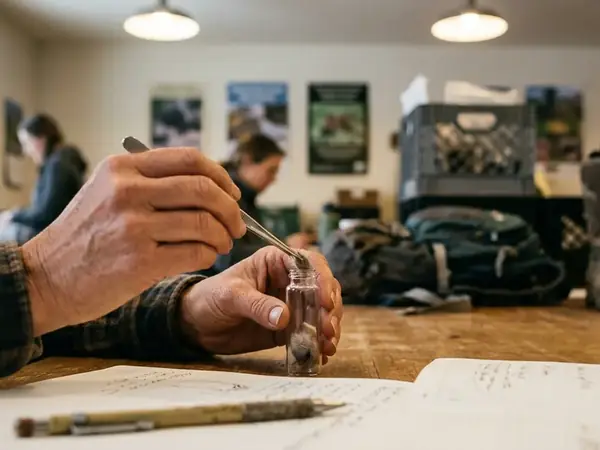
- Using clean forceps or wooden applicators for sample collection.
- Placing each item in separate containers to isolate variables.
- Maintaining written chain-of-custody notes from the forest to the laboratory.
We strictly avoid bare-hand contact with hair roots or scat surfaces. A single mistake here renders the sample useless for advanced testing.
Field Solutions: Advanced Track Casting Techniques
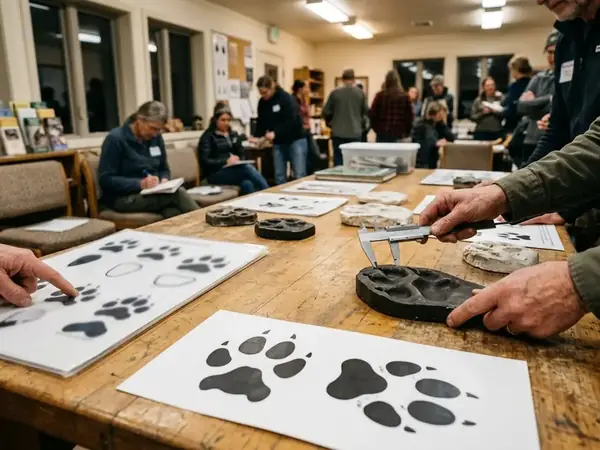
When we find a track, the immediate field decision is whether the impression contains enough detail to justify casting and how to capture it without damaging the print. Drawing on a review of Robert L. Downing's technical paper on track identification, the methodology becomes clear. We use casting to supplement visual records, much like West Virginia Division of Natural Resources officer Larry Guthrie's photographic documentation of a cougar in 1976.
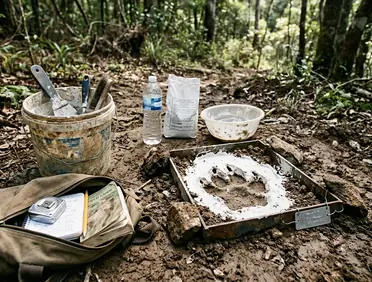
Dental stone is the preferred material for high-quality, high-detail track casts. It sets harder than ordinary Plaster of Paris and captures finer surface relief, including dermal ridge-like texture when the substrate preserves it. Even dental stone cannot recover pad detail from loose sand, slumped mud, leaf litter, or a print that has already filled with water. The substrate dictates our success.
The process requires patience. I photograph the track, frame it, mix the dental stone to a pourable consistency, and pour beside the impression rather than directly onto the deepest point. Once it hardens, I lift and label the cast.
Laboratory Solutions: DNA Analysis and Necropsy Protocols
Once a carcass or tissue sample is recovered, the path moves from field description to necropsy, sample preservation, and genetic comparison. A necropsy led by Alan Woolf at Southern Illinois University on an Illinois specimen set a standard for this transition, though we must acknowledge that necropsy findings alone cannot definitively establish geographic origin without corroborating genetic markers.
Consider the June 1997 case of an 8-pound cougar kitten killed on Highway 850 in Floyd County, Kentucky. DNA analysis successfully identified South American maternal ancestry in the kitten. This genetic classification process compared the sample against reference genotypes from known North American and South American cougar lineages. The results proved the animal was a released or escaped captive—rather than evidence of a remnant native eastern population.
Necropsy evidence can also identify captive-history clues such as abnormal wear, healed injuries, diet residues, or parasites inconsistent with the local area.
Caution: Scat and tissue DNA degrade rapidly due to refrigerator freeze-thaw cycles. A sample moved repeatedly between cold storage, room-temperature examination, and refreezing will lose viability before laboratory testing.
Results: Legal Protections and Conservation Impact
The policy decision follows the scientific classification. If the evidence shows a native or protected taxon, agencies can treat the record as conservation-relevant proof. If it shows captive or non-native origins, the focus shifts to escape prevention and reporting protocols.
The eastern cougar was added to the Endangered Species List in 1973. This listing interacts directly with the 'Similarity of Appearance' legal clause, which provides crucial protection for non-native wild cougars that might be mistaken for the protected native subspecies, reducing the enforcement problem created by visually indistinguishable animals.
For rewilding advocates, including organizations like the Eastern Cougar Foundation, definitive proof impacts broader initiatives. A confirmed native lineage supports claims of remnant persistence. A confirmed captive origin redirects the case toward public communication and regulatory enforcement.
Sharing the Data: The 6th Mountain Lion Workshop
Moving evidence from a local rumor or agency file into a technical forum where methods can be questioned is a vital step. The scientific value lies in peer scrutiny of evidence standards. We must determine what counts as a confirmed record, what remains probable, and what must stay unverified.
Building on records from the 6th Mountain Lion Workshop held in San Antonio between December 12-14, 2000, the importance of data sharing becomes evident. The Eastern Cougar Foundation, a registered 501(c)(3) non-profit, presented a technical paper at this event. Leadership driving these ongoing data-sharing efforts included ECF President Todd Lester and Vice President Chris Bolgiano. They translated scattered field reports into structured, testable data.
The Ongoing Work of Wildlife Verification
Steve Thomas of the Kentucky Department of Fish and Wildlife Resources kneels in the damp soil of a dense Appalachian forest. He carefully pours liquid dental stone into a fresh, wide feline track. The smell of wet earth rises as he works in absolute quiet, demonstrating the precise patience required to secure a single piece of undeniable physical evidence. Rain threatens to wash the impression away at any moment. He watches the gray mixture settle into the cohesive mud, capturing the fine pad detail that will soon be archived and compared alongside photographs and genetic samples.