When a Verified Cougar Photo Appears in Your County, Does It Mean the Cat Lives There?
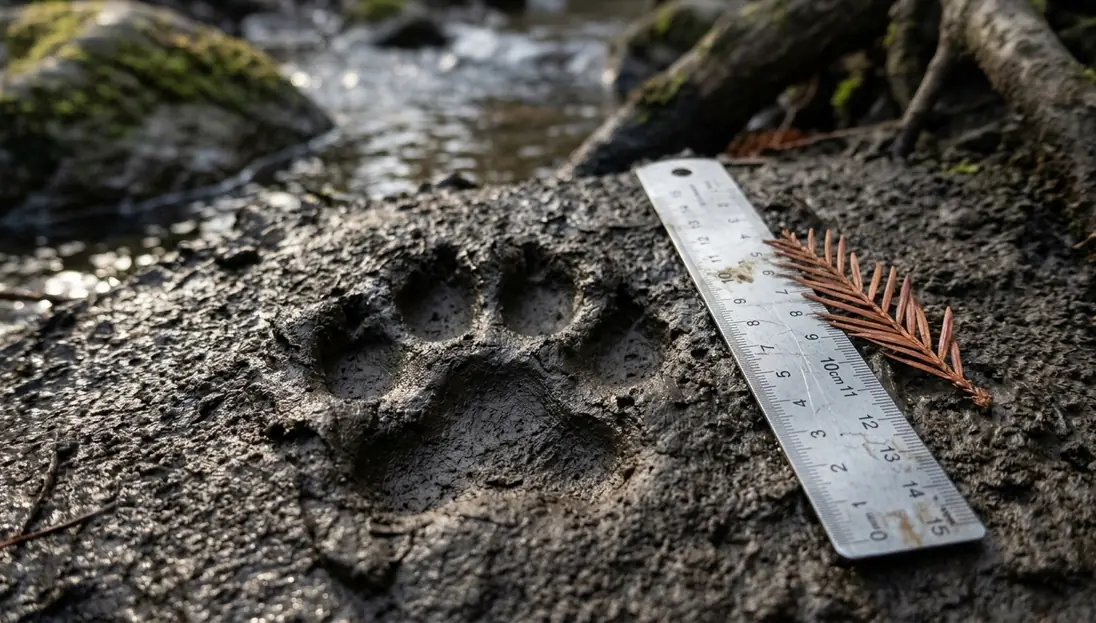
Does a verified trail-camera photograph or an unmistakable paw print in mud prove that a cougar lives in your county? No. A confirmed single detection proves physical presence at one specific place and moment. It tells us a cougar stood in front of a lens or crossed a logging road, while leaving the animal's territorial status completely open.
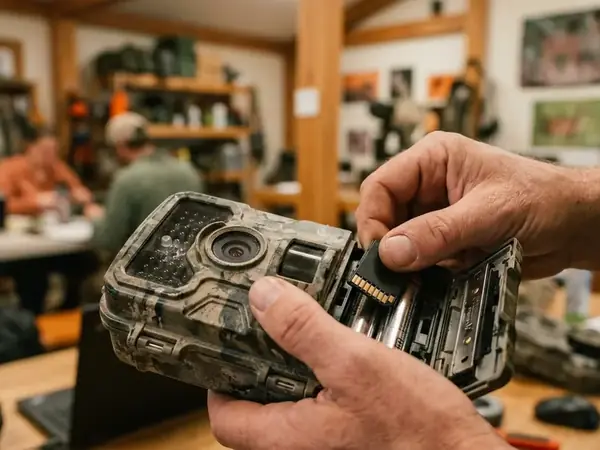
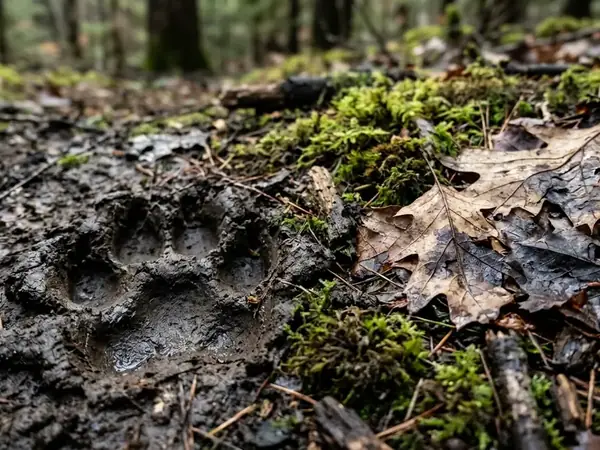
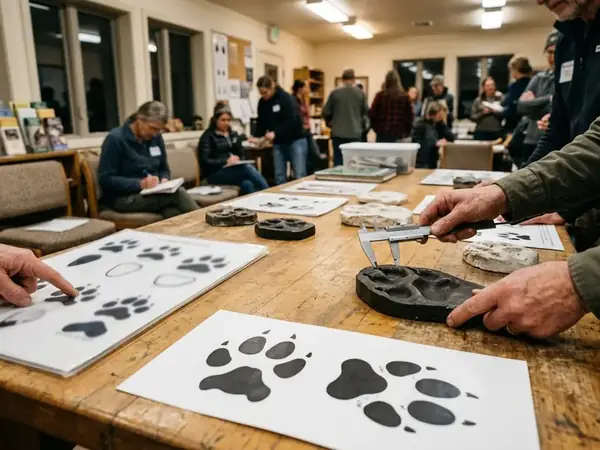
Verification is only the starting gate. When I review a submitted image, the initial audit examines diagnostic anatomy—the long cylindrical tail reaching past the hocks, the rounded ears, the compact skull—alongside image provenance to confirm the camera location and timestamp. When evaluating tracks, the review looks at diagnostic pad impressions and the broader trackway context, because a single oversized print in soft silt rarely holds enough detail to rule out a large dog. Once a record passes that threshold, the first task is finished: we have confirmed species, location, and observation context.
Assigning ecological status is a separate investigation entirely. Public discussions frequently collapse every confirmed record into claims that cougars are "back" in a county, treating presence as permanence. During evidence review, we separate confirmed occurrences into three distinct ecological categories:
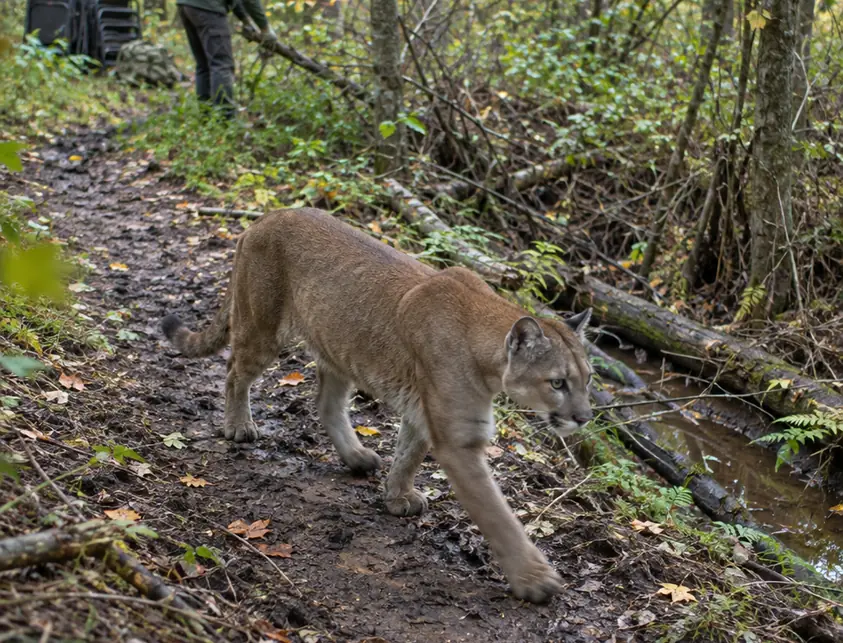
- Transient dispersers: Cougars moving away from their natal range or traveling through unfamiliar habitat without maintaining a local territory.
- Established residents: Identifiable individuals that repeatedly use and maintain a bounded home range across multiple seasons, which frequently straddles multiple county lines.
- Breeding populations: Cougars reproducing locally, demonstrated by verified offspring or family groups rather than the mere presence of adult cats.
A single trail-camera frame cannot distinguish between those three realities. To find out whether a cat is passing through or settling down, we have to look at what happens after the shutter clicks.
Markers of a Transient Cougar Passing Through
Long-distance dispersal drives almost all verified cougar detections outside established breeding zones. Young males in particular leave their birth territories and travel across unfamiliar landscapes in search of available habitat and mates. On a regional map, these journeys often look remarkably directional, crossing multiple counties, state lines, and watershed boundaries. On the ground, the actual path includes detours, river crossings, and temporary multi-day stops where prey is abundant.
Because a transient cat keeps moving, the physical evidence it leaves behind follows a sparse, linear pattern. Reviewers looking at a disperser typically see isolated trail-camera captures that never repeat at the same site, a one-time vehicle strike or recovered road-killed animal, or a directional track line in snow that enters a parcel and continues out the other side without looping back. An isolated camera image or roadkill recovery establishes occurrence on that date, and a single straight trackway gives us short-term movement direction, though neither record by itself proves the animal's broader status. The picture clarifies when successive verified detections appear along a geographic progression over weeks or months, tracing a path across the map.
Corridor Report Clusters: Dozens of unverified public sightings along a single river valley or highway corridor rarely signal multiple local cougars. Publicity around one confirmed photo often triggers a wave of speculative reports, while a single traveling cat crossing bridges or linear agricultural edges can generate repeated eyewitness calls along its route. Counting raw sighting reports as separate animals drastically inflates perceived cougar numbers.
Reconstructing an accurate movement route requires strict separation between verified physical records and unverified eyewitness accounts. When we strip away uncorroborated reports and plot only confirmed photographs, genetic samples, or tracks on a timeline, an apparent regional invasion usually resolves into one young male walking across the state.
What Repeated Detections Reveal About an Established Resident
Establishing residency requires linking repeated detections to the same individual within a coherent home range across multiple seasons. A scatter of unlinked cougar records across a large watershed over several years does not meet this standard. Instead, reviewers look for an identifiable animal returning to the same canyon systems, ridgelines, and travel corridors over time. Because survey coverage, individual identification quality, and the spatial layout of repeated movements all determine the strength of a residency inference, no universal detection count or fixed elapsed-time cutoff automatically proves a cougar has settled in.
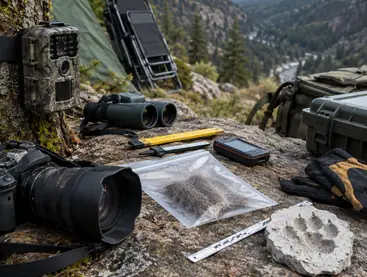
Field evidence of territorial behavior strengthens the spatial map. Resident cougars routinely create scrapes—raking forest litter, oak leaves, or soil into a small mound at the base of a landmark tree or along a ridge trail to deposit scent signals. Finding fresh scrapes repeatedly at the same community scrape tree points to ongoing area use, even though a scrape by itself carries no individual signature. Similarly, a cached large-prey carcass covered in needles and debris documents localized feeding. When camera traps or track beds show a cougar returning to feed on that carcass over several days, it confirms temporary occupancy of a kill site, which then serves as one anchor point inside a broader seasonal monitoring effort.
Connecting Records Through Individual Identification
To prove that a winter kill site, a spring scrape, and an autumn trail-camera photo belong to one resident animal rather than two transients passing through the same bottleneck, we need individual identification. In practice, that connection relies on two primary methods:
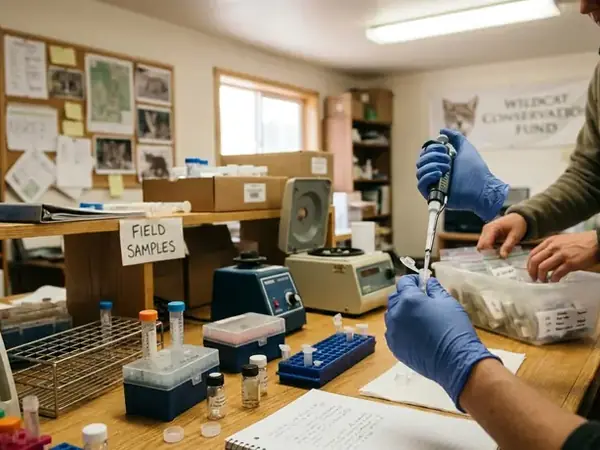
- DNA analysis of non-invasive samples: Scat deposited near a scrape or hair snagged on bark or barbed wire can yield an individual genetic profile. Connecting locations through genetics demands strict field and lab protocols: keeping samples separate in the field, preventing cross-contamination, logging exact coordinates, and running rigorous laboratory quality checks.
- Distinctive visual markers on camera traps: High-resolution trail cameras can match an individual across locations when the images capture a stable physical abnormality, such as a crooked heal on a tail kink, a notched ear, or a distinctive body scar from a past fight. Standard anatomical features—such as the normal dark tip found on every adult cougar's tail—are never distinctive enough to link separate photos.
Residency review reaches completion only when individual identity links, mapped spatial returns, multi-season coverage, and territorial signs align into a single coherent home range.
Why Confirming a Breeding Population Requires More Than Adult Sightings
Confirming a resident cougar often sparks immediate claims that a self-sustaining population has returned. In reality, reproductive assessment begins as a completely separate investigation from residency. Proving that an adult male holds a multi-county territory tells us nothing about whether females or offspring exist anywhere nearby. Even documenting two overlapping adult cougars of unknown sex on the same trail camera network does not establish a breeding pair, mating behavior, or successful reproduction.
Confirming local reproduction demands hard physical proof of young or genetic lineage:
- Verified documentation of dependent young: Clear photographs, video, or trackways showing an adult female traveling with spotted kittens provide direct proof of a reproductive family group.
- Occupied reproductive dens: Documenting a female and nursing kittens inside a rocky shelter or dense thicket provides much stronger location-specific proof of reproduction than finding an empty rock cleft with old bones outside.
- Genetic parentage matching: While DNA analysis easily separates male and female samples, simply detecting both sexes in the same forest does not prove they bred. Genetic proof of reproduction requires sampling local offspring alongside candidate adults to run informative parentage comparisons.
Even when one litter is verified, careful analysts distinguish a single reproductive event from an established breeding population. Confirming a persistent population requires evidence that reproduction and territorial occupancy continue beyond a single cohort of kittens.
The biological hurdle here comes down to female dispersal behavior. While young male cougars routinely travel hundreds of miles across fragmented habitats, females generally disperse over much shorter distances, typically settling near the edges of their mothers' home ranges. Because females expand their geographic footprint so conservatively, verified female presence acts as the true biological limiting factor for natural recolonization. While an absence of female or kitten detections never proves that females are absent from a dense forest, reviewers cannot credit an area with a breeding population until direct evidence of females and offspring appears in the record.
Side-by-Side Comparison: Auditing Local Cougar Presence Claims
When a county agency or citizen group claims local cougar residency, an evidence audit separates verified records from hearsay and scores the confirmed data across four criteria: temporal continuity, spatial distribution, physical sign type, and individual identity. Every claim receives only the highest ecological status that its verified physical records can prove.
| Criterion | Transient Passage | Established Residency | Breeding Population |
|---|---|---|---|
| Time span between detections | Single occurrence, or a brief sequence of records moving across consecutive dates. | Recurring detections of the same animal across multiple seasons. | Repeated documentation of reproduction and occupancy extending beyond a single litter. |
| Spatial distribution | Isolated point or a directional route crossing jurisdictions without looping back. | Clustered, recurring returns within a bounded home range. | Home range occupancy encompassing natal dens and overlapping female and male territories. |
| Physical sign types | Single camera frame, directional track line, roadkill recovery, or opportunistic prey kill. | Revisited prey caches, recurrent territorial scrapes, scent mounds, and repeated camera captures. | Camera captures of spotted kittens, occupied natal dens, or juvenile remains/tracks alongside an adult female. |
| Individual identification | Species confirmation required; individual matching shows progressive away-movement if multiple samples exist. | Mandatory matching across seasons via DNA profiles or unmistakable, stable physical scars. | Sex identification confirming adult females, direct visual confirmation of kittens, or genetic parentage linking local offspring to adults. |
Two common pitfalls routine audits uncover are conflating record counts with individual counts and treating multi-year gaps as continuous occupancy. A single resident or slow-moving transient can generate three trail-camera photos, two track sets, a hair sample, and fifteen neighborhood phone calls in a single month; keeping record tallies separate from individual tallies prevents artificial population inflation. Likewise, two verified cougar photos taken in the same river basin several years apart do not establish continuous occupancy when the intervening period holds zero identity or movement links connecting the animals.
Step-by-Step Evaluation of a Multi-Month Trail Camera Sequence
To see how these verification rules work in practice, consider a hypothetical case file from a single forested valley. Over an eight-month span, local monitors submit three pieces of physical evidence from the same watershed: an autumn trail-camera photograph, a winter white-tailed deer carcass cached under brush with nearby cougar tracks, and a spring territorial scrape containing shed hair. Each record must pass three distinct evidentiary checks before you can assign an ecological status to the valley.
Step 1: Audit the Autumn Camera Trap Image
You begin by verifying the autumn photograph independently of the later finds. You check the animal's morphology—confirming the long tail, hind-quarter proportions, and cranial shape—and audit the image metadata and site photos to confirm the camera actually sat in the reported valley. Next, you inspect the high-resolution file for individual markers. The cat shows a clean coat, standard dark tail tip, and no visible ear notches or body scars. Because the hindquarters are partially obscured by ferns, the image provides neither reliable sex identification nor a unique visual signature. At the end of Step 1, you have verified cougar occurrence in autumn, with no link yet to what happens in winter.
Step 2: Process the Winter Deer Cache and Trackway
Three months later, a monitor documents a deer carcass dragged into a hemlock draw and buried under raked leaf litter, surrounded by diagnostic feline tracks showing four asymmetric toes, a tri-lobed heel pad edge, and no claw marks. The raked covering and repeated tracks around the carcass confirm that a cougar made or claimed the kill and returned to feed over multiple days. However, tracks and a buried deer do not identify which individual cougar is feeding. While inspecting the brush pulled over the carcass, the field team locates snagged guard hairs with intact follicles, places them in a sterile paper envelope using clean forceps to prevent contamination, logs the GPS coordinates, and submits the packet for DNA analysis. That sample yields a complete individual cougar genotype and a male sex marker.
Step 3: Link the Spring Scrape and Assign Final Status
In spring, two miles up the same valley ridge, a monitor photographs a fresh territorial scrape at the base of a white pine and collects three snagged hairs from the bark using the same contamination controls. Genetic testing extracts a complete genetic profile and sex marker from the spring hair. When you compare the spring genotype against the winter carcass sample, the individual markers match across all tested loci, confirming the same male cougar left both samples.
Now you assemble the full valley dossier:
- The winter and spring records are genetically linked to one identifiable male cougar returning to the same valley across two seasons and displaying territorial scraping behavior. That linkage crosses the threshold from transient occurrence to an established resident male.
- The autumn trail-camera photo remains an unlinked verified occurrence. Without an associated hair sample from that camera site or a distinctive physical scar visible in the photo and documented on the winter cat, you cannot claim all three records belong to the same animal. Your final tally is one unlinked autumn detection plus two genetically matched seasonal detections of a resident male.
- Finally, you audit the file for reproductive proof. A genetically confirmed resident male establishes territory occupancy, yet the valley file contains zero evidence of adult females, spotted kittens, natal dens, or genetic parentage. You formally rule out a confirmed breeding population while logging the valley as an active male home range requiring continued multi-season monitoring.