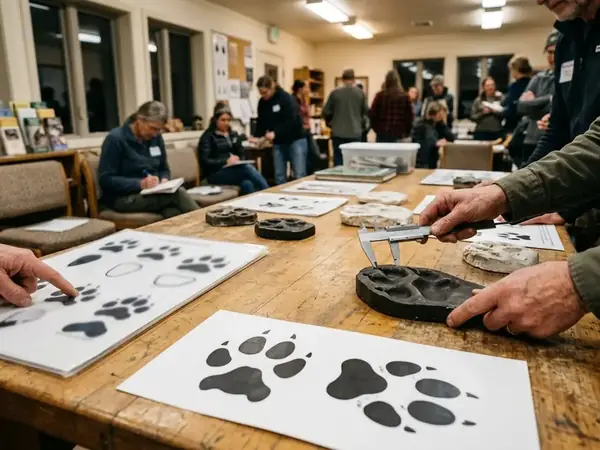
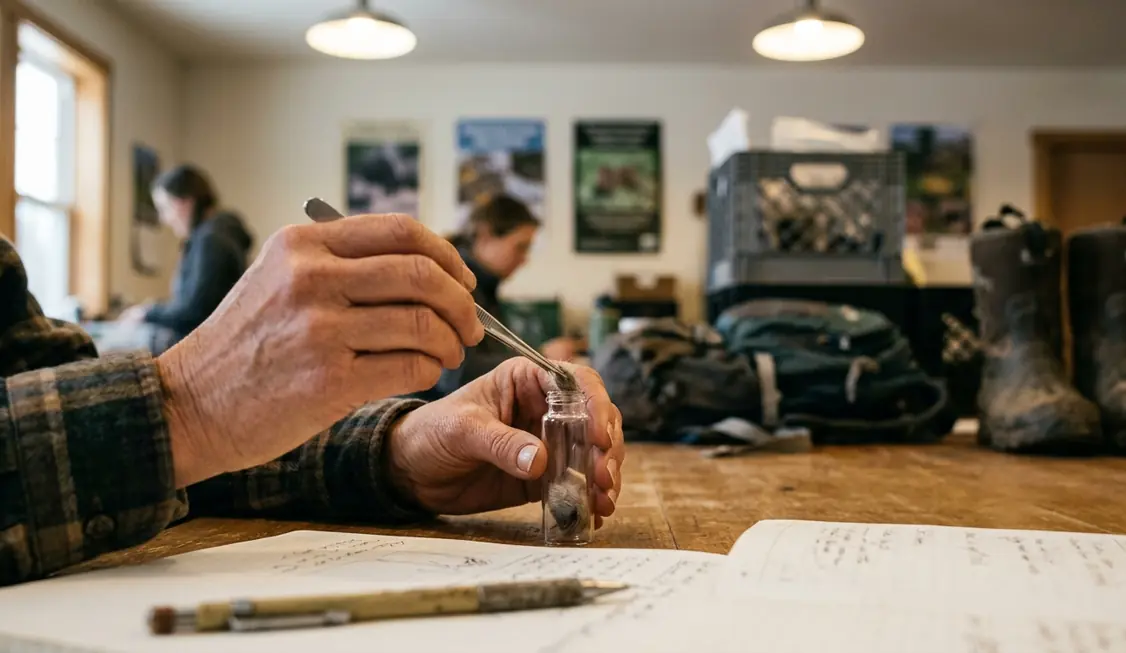
The highest-value documentation window for a cougar encounter opens the moment the animal departs and closes within approximately 48 hours. Rain, thawing, wind, insects, sunlight, and human or animal traffic progressively alter the scene, degrading the physical trace evidence required for scientific verification. Field priorities center entirely on what an independent reviewer can inspect after the observer has left the area. A preserved trackway, scat deposit, snagged hair, scrape, or cached prey site retains measurable features and may contain extractable DNA. An unsupported visual sighting relies heavily on memory, distance, light, and expectation, making it difficult to verify objectively.
Prioritizing the 48-Hour Trace Window
The mindset of a field researcher requires prioritizing site preservation over immediate pursuit. Stop, document the scene, and protect the sign. Record the relationship among all visible signs at the location. Document the direction of travel, the distance between successive tracks, nearby cover, substrate changes, and the specific position of scat, hair, or a scrape within the trackway.
A continuous sequence of tracks carries immense diagnostic information. Reviewers rely on multiple impressions to compare gait, stride, registration, and changes across different substrates. An isolated impression provides a limited snapshot, whereas a complete trackway reveals the animal's movement mechanics and behavioral context.
Establishing a Perimeter Around Fresh Sign
The immediate decision upon discovering fresh sign involves determining whether the site can be documented safely without adding footprints or scent. Stop moving immediately. Scan the area from where you stand and retreat along your existing approach if necessary. Keep companions and domestic animals strictly outside the discovery boundary.
Mark the outer boundary with three or four visible reference markers. Place these markers at least one full human stride beyond the outermost track, scrape, scat deposit, hair snag, or disturbed vegetation. Photograph the scene before installing any temporary cover. Do not tie flagging directly to a branch holding a hair sample, as this risks dislodging the material.
Temporary Weather Protection
Imminent rain requires immediate, careful intervention to protect fragile impressions. Place a clean, rigid bucket or similar cover upside down with its rim entirely outside the impression. Weight or anchor the cover outside the evidence area without driving stakes through the trackway. The bucket-rim boundary must shelter the substrate around the paw print, never the paw print itself.
If bark is the only shelter available, support it above the track so it cannot touch the walls or floor of the impression. Always photograph the uncovered track first before applying any improvised shelter.
Weather Protection Limits An improvised cover can briefly deflect rain from an isolated track. It does not stop flooding, wind-driven sediment, condensation, or substrate collapse. Never place temporary cover over scat, hair, or a prey cache.
Calibrating Photography for Morphological Review
The photographic sequence is designed from broad context toward microscopic detail so reviewers can reconstruct where the impression sits before examining toe and pad geometry. Always use a standardized measuring tool, such as a ruler or measuring tape. Keep the scale level with the track surface. Coins and keys fail as scale markers because their dimensions may be unknown to reviewers and perspective distortion makes them misleading.
Begin with a wide photograph showing the trackway and surrounding habitat. Follow this with a perpendicular close image of each clear print, ensuring the entire ruler is visible in the same plane as the impression. Preserve the original image files without cropping or applying filters.
Illuminating Track Depth
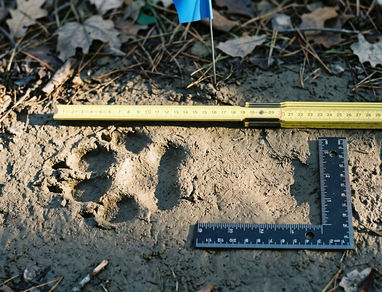
Flat daylight obscures the subtle ridges and contours of an animal track. Hold a flashlight roughly 5 to 15 centimeters above the substrate and sweep the beam from several directions. Low oblique light casts short shadows along pad lobes, toe edges, scrape ridges, and possible claw impressions, revealing morphological details invisible under direct overhead light.
Capture at least one view from each end of the track and one from each side after completing the top-down image. Angled views reveal wall depth and substrate displacement that a perpendicular photograph suppresses. Photograph multiple successive tracks when available and include separate close views of the heel pad, toe arrangement, and any scrape mound rather than selecting only the cleanest impression.
Isolating Scat and Hair for Genetic Extraction
Collection follows documentation. Photograph the material in place before attempting any transfer. Prelabel a paper packet, put on clean disposable gloves, and use a sterile disposable tool when available. A clean, dry twig serves effectively as a single-use transfer tool. Alternatively, an inverted paper bag can be placed around a sample and turned right-side out without hand contact. Each sample receives a separate tool, glove set, and container to prevent cross-contamination.
Label the outside of each paper envelope or bag with a unique sample code, discovery date and time, coordinates, material type, and collector initials before adding the specimen. For snagged hair, handle the shaft rather than brushing or scraping the root end. Preserve every strand and any attached root tissue in a folded paper packet inside a labeled paper envelope.
For scat, photograph all surfaces before transfer and retain the exterior material, where shed intestinal cells may occur. Do not combine separate deposits even when they are only a short distance apart.
Moisture Degradation Risks Never seal fresh or damp hair or scat in an ordinary plastic bag. Trapped moisture encourages microbial and fungal activity that rapidly degrades genetic material. Use breathable paper packaging and keep it dry, cool, and out of direct sunlight while awaiting instructions.
Record every transfer in a simple custody log detailing the sample code, the person holding it, the date and time, the action taken, and the destination. Drawing on wildlife genetics protocols, maintaining a clear chain of custody ensures the material remains viable for genetic analysis.
Capturing Environmental Metadata and Coordinates
Metadata must be recorded while the observer is still at the site because later reconstruction tends to blur weather timing, substrate changes, and travel direction. Save a waypoint, copy the displayed coordinates into the field record, retain a screenshot, and write down the device's reported horizontal uncertainty.
Record latitude and longitude in decimal degrees, the coordinate datum if the device exposes it, the exact local discovery time with time zone, and the phone's displayed accuracy estimate. Under heavy canopy or beside steep terrain, remain stationary for half a minute or so and save repeated readings rather than reporting extra decimal places as certainty. Smartphone positions can wander by tens of meters in obstructed conditions.
Documenting Substrate and Weather Variables
Describe precipitation, thawing, strong wind, or major temperature change during the preceding day or two. These environmental variables directly affect edge sharpness, track enlargement, scent persistence, and apparent age. Name the substrate precisely, noting conditions such as wet clay, powder snow, crusted snow, sand, leaf litter, pine needles, or decomposed wood.
Record the slope, travel bearing, nearby water sources, roads, fences, and cover transitions. Keep sensitive coordinates out of public posts and transmit them directly to qualified wildlife reviewers so a possible animal, den, cache, or evidence site is not disturbed.
Packaging the Field Record for Agency Analysis
Submission is organized as an evidence package rather than a narrative claim. Contact the appropriate state wildlife authority or qualified carnivore-research nonprofit on the day of discovery, or the following day at the latest. Ask whether physical material should be collected or transferred, and obtain a case or submission identifier.
Send original, unedited image files with embedded metadata intact. Include a numbered photo index explaining which frame shows the landscape, trackway, scale view, oblique light, scat, hair, scrape, or sample location. Provide the coordinates, reported GPS uncertainty, discovery time, recent weather, substrate, travel direction, observer contact information, field notes, and a sample manifest.
- Stop and keep people and domestic animals behind the discovery point.
- Do not pursue the animal or approach a fresh carcass or cache.
- Photograph the undisturbed scene and complete trackway first.
- Place a ruler in the same plane as the track for scale.
Keep biological samples separate from digital media and do not mail them until the receiving organization supplies handling instructions. Retain duplicate field notes and original files. Image triage and genetic analysis operate on different schedules, so the receiving authority should provide the only defensible turnaround estimate. Depending on the extraction methodology used, the review process proceeds from location and image triage to morphological comparison and finally genetic sequencing.
A hair carrying attached follicular tissue can yield nuclear DNA, while shaft material may retain mitochondrial DNA. Species can be confirmed from a usable profile, and comparison with suitable reference populations assigns a dispersing cougar to a likely source population.