A Thawing Logging Road in the Northern Hardwood Forest
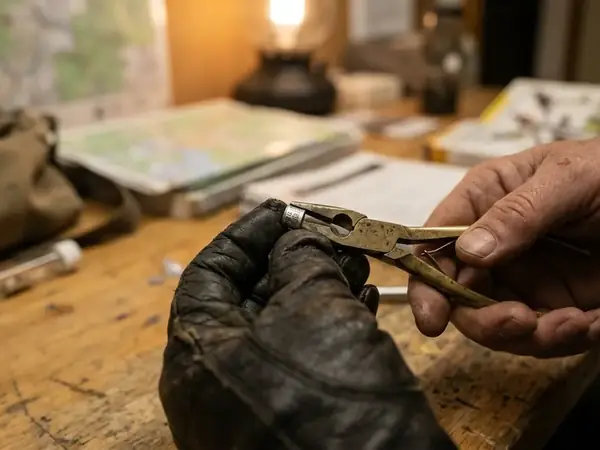
On a winter tracking survey along an Appalachian ridgeline, a technician kneels beside cylindrical, tapered scat. A guard hair catches on the broken branches of a blown-down spruce nearby. Afternoon temperatures have climbed above freezing. Before opening a sterile vial, the technician photographs the deposit, places a scale beside it, and records whether its surface remains frozen, has begun thawing, or is wet.
This field-to-laboratory reconstruction illustrates a collection decision, rather than documenting an investigation with measured results. The team carries limited sterile containers and must reserve laboratory capacity for samples that can answer a conservation question. Every specimen collected creates obligations: preservation, transport, extraction, controls, interpretation, and storage.
The immediate target lies on the scat's exterior. Sloughed intestinal cells from the animal that deposited it can remain on that surface; the interior can contain abundant prey material. A vial may therefore hold considerable recoverable DNA while yielding little usable predator nuclear DNA, especially when prey material, microbes, and inhibitors dominate the extract.
Above-freezing air raises concern about preservation, but it does not reveal the specimen's previous temperature history. The field record must distinguish a direct observation from an inference. “Thawing at collection” provides useful evidence. “Repeatedly thawed before discovery” requires information the technician may lack.
Suspected cougar reports bring candidate material from bobcats, coyotes, domestic dogs, and other mammals into the same collection stream. Appearance can guide triage; species verification determines whether a specimen supports a puma occurrence record. The snagged hair receives separate packaging and its own identifier. Even close proximity cannot establish that the hair and scat came from the same animal.
Sorting Felid Sign from Canid Impostors at the Collection Site
The first decision gate occurs before the collector touches a tube. With limited containers, the strongest candidate combines recoverable material with an interpretable setting. Morphology helps rank that candidate without settling its identity.
- Measure an intact segment. Record scat diameter in millimeters at an uncompressed section. Photograph the scale and describe blunt and tapered ends separately. A tapered end alone cannot distinguish a cougar deposit from competing possibilities.
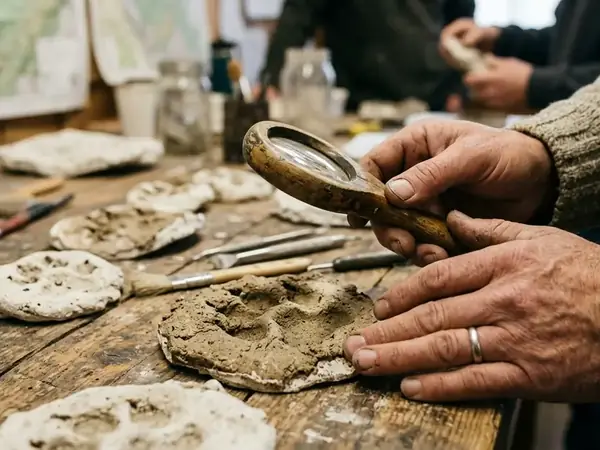
- Follow the track sequence. Record track measurements in centimeters and examine gait beyond the deposit. Stride measures the distance between successive impressions of the same foot; spacing between adjacent prints describes something different. Keep those measurements distinct.
- Document the surrounding sign. Photograph scrape mounds and their relationship to the scat. Scraping supplies context, but its presence does not identify a cougar. Record whether the tracks genuinely connect with the deposit or merely cross nearby.
Under the reconstruction's proposed collection rubric, the field queue has three tiers:
- Tier 1: Fresh scat on snow with a clearly associated felid track sequence.
- Tier 2: Weathered scat retaining an apparent mucus coating.
- Tier 3: Opportunistic hair or bone fragments without associated tracks.
These tiers describe a project-specific allocation rule, not a standardized wildlife-genetics classification. Freshness, substrate, material type, and track association still need separate entries. Otherwise, a later audit cannot determine whether the tier reflected specimen condition or the collector's confidence in the tracks.
Why Rain-Washed Scat Moves Down the Queue
Moisture encourages microbial activity and enzymatic DNA degradation. As host DNA fragments or becomes scarce, environmental microbial DNA can occupy a growing share of the extract. An ambiguous, rain-washed specimen therefore carries two burdens: uncertain identity and uncertain molecular usefulness.
Under a strict vial budget, the technician may photograph and leave that deposit, or assign it secondary status if the project permits collection. The record should retain the reason. A collection rule that simply says “poor sample” conceals the distinction between weak field context and unfavorable preservation.
Matching Silica Desiccation and Ethanol Swabs to Sample Condition
Preservation begins with the receiving laboratory's accepted method. Whole-scat desiccation and targeted surface sampling solve different handling problems, and neither route tolerates improvised loading or undocumented delays.
With whole-scat desiccation, color-indicating silica removes moisture from the specimen. The collector follows the laboratory's specified sample-to-desiccant loading and inspects the indicator during transport. A dry-looking exterior can conceal a moist core, so the appearance of the scat alone cannot establish adequate drying.
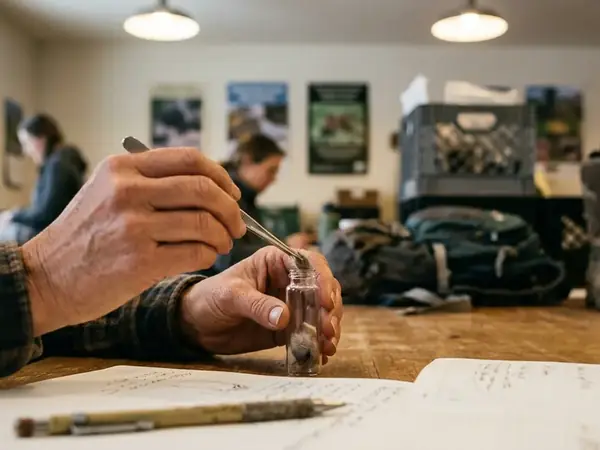
Targeted surface sampling transfers material from the host-cell-bearing exterior into the laboratory's specified lysis buffer or high-grade ethanol. It reduces the fecal bulk carried out of the forest and limits deliberate contact with the prey-rich interior. The collector works along the lateral surface, avoiding exposed contents, soil, and surrounding meltwater.
Replacing the Cooler With a Defined Surface Transfer
The reconstruction makes one explicit method change: pack-out logs reveal repeated thawing during cooler-based bulk transport, prompting the team to adopt targeted outer-surface collection. The rationale is prompt stabilization of the host-rich exterior and less unnecessary fecal material in the pack.
That observation does not demonstrate that thawing released deer or snowshoe hare DNA into the samples. Such a mechanism would require paired evidence. The defensible operational finding is narrower: the transport system failed to maintain its intended condition, so the team selected a laboratory-approved preservation route better suited to the pack-out.
- Choose the route before collection. Confirm whether the receiving laboratory accepts a dried specimen, a surface transfer into buffer, or an ethanol-preserved swab.
- Record the preservation inputs. For ethanol, log the starting concentration and use the specified liquid volume. Water carried by a wet swab dilutes the preservative.
- Keep the clocks separate. Record collection time and stabilization time as distinct entries. Their interval remains visible even when collection and preservation occur close together.
- Maintain separate media. Keep desiccation and liquid-preservation workflows distinct. Do not add silica to an ethanol-filled vial.
Weathered Mucus Boundary
Silica, ethanol, and lysis buffer preserve DNA that survives until collection. They cannot reconstruct host DNA already lost through weathering. Several days of sunlight and warm rain warrant concern, but recoverability has no universal elapsed-day cutoff.
The practical comparison concerns the complete handling route. A carefully collected surface swab with an undocumented preservation delay remains difficult to interpret. A properly loaded desiccation container with complete timestamps gives the laboratory a more useful account of what happened between discovery and intake.
Breaking the Cross-Contamination Chain Inside the Field Pack
Every container opening creates an opportunity for foreign DNA to enter. A high-priority specimen can lose interpretive value through shared tools, contaminated gloves, or packaging that allows reference material to contact the collection kit.
Flaming reusable forceps does not provide a validated guarantee of DNA removal. Inadequately cleaned tools can transfer biological residue between specimens. Likewise, prey reference remains stored beside putative predator hair create an avoidable source of confusion. Those materials travel in a separate container.
The collection sequence assigns clean and handled materials different places in the workflow:
- Prepare the specimen identifier, collection materials, and approved preservation medium before sampling.
- Use fresh gloves for each specimen and a sterile, single-use wooden applicator for the designated surface-transfer method.
- Close the primary vial before handling paperwork or other equipment.
- Place each closed vial in its own secondary bag, then place that bag inside a clean outer transport bag.
- Document transfers between collectors, transport personnel, and laboratory intake.
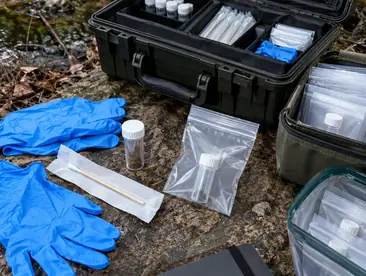
Chain-of-custody entries establish who handled a specimen and when. Contamination controls examine whether foreign DNA entered it. Both records matter, and neither substitutes for the other. Field blanks prepared with the same collection materials and exposed during sampling accompany laboratory extraction and PCR controls.
The Metadata That Travels With Each Vial
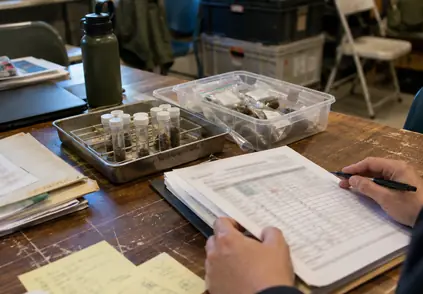
The record includes substrate, canopy cover, ambient temperature, time since the last known precipitation, preservation method, and collector identity. It also retains the observed frozen, thawing, or wet condition and the collection and stabilization timestamps. A specimen identifier must connect those observations to the correct container.
When precipitation history cannot be established, the collector records “unknown.” That explicit uncertainty differs from an omitted field. Under the proposed queue policy, missing required metadata lowers priority before extraction; an honest unknown remains available for interpretation.
The same discipline applies when adapting noninvasive genetic sampling protocols for carnivores: the field procedure and the receiving laboratory's requirements need to agree before collection begins.
Screening Mitochondrial Markers Before Committing to Microsatellites
Laboratory triage begins by reconciling each vial with its identifier, field record, and preservation history. A persuasive track photograph cannot repair a mislabeled container. Once intake resolves those records, a validated short-fragment mitochondrial DNA assay can address the first biological question: which species contributed the target material?
Mitochondrial genomes generally occur in many copies per cell, whereas most autosomal nuclear loci have two copies per diploid cell. That abundance difference supports mitochondrial screening of degraded material before committing resources to individual identification. It does not make every mitochondrial result an adequate account of the scat producer.
Assay specificity matters. Broad vertebrate primers can recover prey DNA from a carnivore scat. The screening assay must discriminate the target carnivores, and the laboratory must interpret the result alongside its controls. “DNA amplified” is an incomplete answer when the conservation question concerns puma presence.
Three Decisions After Species Screening
- Confirmed puma material: Assess host nuclear DNA and decide whether individual identification or sex testing is justified.
- Another identified species: Record that result against the specimen rather than advancing it through a puma individual-genotyping workflow.
- Weak or unresolved amplification: Review inhibition, replication, and host-DNA quantity before deciding whether further work has a reasonable prospect of resolving the sample.
A weak mitochondrial signal should not trigger automatic rejection. Inhibition and scarce target DNA require different responses. Conversely, one successful amplification cannot establish a reliable individual genotype. Microsatellite work needs checks for allelic dropout and false alleles; individual identification depends on replicated, quality-controlled multilocus results. The decision to pursue a SNP panel likewise follows the laboratory's assessment of usable nuclear DNA.
This staged approach protects the assay budget by matching expenditure to the question the specimen can answer. Species identification, individual identification, and sex testing are separate analytical commitments.
Testing Whether Wet Soil Predicts Failure
The audit joins amplification outcomes to substrate, wetness, preservation delay, extraction batch, and inhibition results. It then compares like-for-like samples. Otherwise, a wet-soil category could absorb failures caused by longer transport delays or a problematic extraction batch.
If comparable wet-soil specimens consistently perform poorly, the project could lower their collection priority and direct limited conservation funds toward better-performing frozen-snow or dry-surface material. The reconstruction establishes no substrate-specific success rate. It supplies a way to test the collection rule before treating substrate as a reliable predictor.
What Changed on the Next Winter Transect After the Lab Audit
The next briefing turns the proposed audit into a field procedure: prioritize contextualized material, collect the exterior with the approved method, stabilize it promptly, and complete identifiers before shipment. Desiccation remains a defined route for suitable material; liquid-preserved surface samples retain their separate handling requirements.
The comparison shifts from how much material the team gathers to how effectively the collection stream answers a question. High-volume opportunistic collection fills containers quickly. Selective, metadata-driven collection makes each shipment easier to evaluate and gives the laboratory explicit reasons for its extraction order.
Fewer shipped vials, fewer unresolved results, and faster verification are outcomes to measure, rather than achievements demonstrated by this reconstruction. The next transect's review should compare:
- Collection-to-stabilization intervals and shipped sample counts.
- Confirmed species results and completion of nuclear genotyping.
- Laboratory turnaround using consistent start and completion points.
- No-call causes separated into failed extraction controls, PCR inhibition, insufficient target DNA, and unresolved species sequences.
Those distinctions direct corrective action. A failed control demands a different response from an unresolved sequence. A verified puma sample supports presence at the collection location and relevant time; a resident or breeding population requires additional, independent evidence.
Read The Silica
Compare the indicator with the reference supplied for that formulation and log its observed state. Indicator colors vary. A dry-state reading documents moisture control after packaging; it cannot establish whether cougar DNA survived before collection.
Late the following winter afternoon, a volunteer tracker kneels beside a freshly scraped hemlock log. The volunteer checks the silica indicator in a single barcoded vial against its supplied reference, records the observed state, and closes the secondary bag. The vial goes into the dry pack. Skis turn toward the logging road while daylight still reaches the snow.